

How AI App Development Companies Are Innovating Education?
- Pooja Paghdal
- Nov 14, 2025
Generative artificial intelligence in education is changing the face of teaching and learning. It is primarily provides exciting tools that personalize the learning process and optimize educational processes.
A new report suggests that the global AI in education market will increase at a compound annual growth rate (CAGR) of over 40% between now and 2030, highlighting the increase of AI-based education app development globally.
As a trained skilled labor force emerges with the rise of AI app development companies and enterprise AI, the education technology sector is applying AI to develop rich learner-centered experiences.
In addition, this trend of AI-based app development services is not only increasing student engagement, but also supporting teachers and administrators for efficiency and impact. Here, we are going to dig in deep and understand every single aspect in terms of Generative AI in education to help you move ahead with clarity. Read on.
What is the Role of Generative AI in Education?
Generative AI is taking on diverse roles in education that are creating a substantial transformation in what it means to be a part of these educational processes.
- For Teachers
Generative AI helps teachers automate lots of routine work, like grading and lesson planning, so they can connect and mentor students face to face. Education app development company experts working with AI generate customized instructional resources and materials that respond to students’ different learning styles. Many of these dialogue platforms around the world can provide on-demand feedback and help improve teaching quality while creating opportunities for open-ended learning with students.
- For Students
When it comes to students, they are considering generative AI as it assists them with personalized learning, adaptive assessments, and chatbots for complete support. In education app development, companies are developing intelligent education apps that analyze a student’s work and change the content as needed to improve understanding based on retention. A tool that promotes self-managed learning at their own pace also provides instant access to different learning resources that better fit learners’ backgrounds, motivations, proficiency levels, or personal interests; all-inclusively providing academic advantages.
- For Educational Administrators and Institutions
Administrators are using generative AI to plan strategically, make data-informed decisions, and manage resources at an institutional level. Enterprise AI solutions can also facilitate analytic enrollment, curriculum development, predictive analytics to improve institutional effectiveness, and other useful management features. These AI app development services can offer capabilities to enable integration into existing systems so that educational institutions can continue developing capacity and involvement in educational processes.
Benefits of Generative AI in Education
Generative AI offers a variety of advantages that address the challenges of contemporary education.
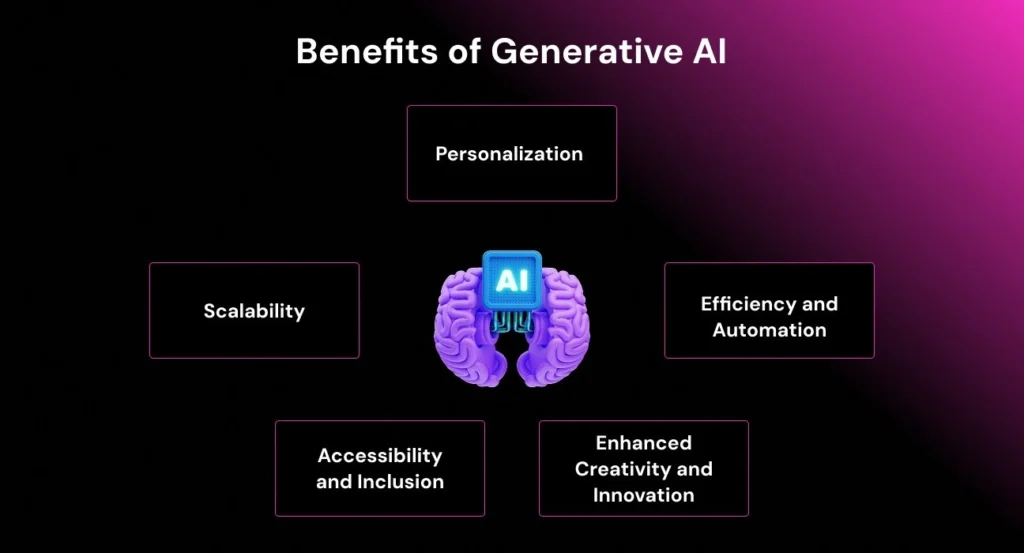
- Personalization: One notable benefit of generative AI is personalized learning for students. Generative AI applications can examine anonymous student information and create personalized learning experiences to improve engagement and support. Personalization can help teachers and students move beyond inaccurate levels of understanding and allow each student to continue at their own instructional pace using their preferred learning style.
- Efficiency and Automation: Automating educational activities and school operations, such as grading assessments, monitoring attendance, and reporting, generative AI helps to ease the burden for educators involved in these tedious processes. Education app developers create robust mobile apps powered by AI that promote efficient school operations and save educators time, allowing them to focus on teaching and engaging students. Automation also improves accuracy while removing the interruption of human resources from human-capital commitments to repetitive work and non-academic obligations.
- Enhanced Creativity and Innovation: Another implication of generative AI is fostering creativity in classrooms. Generative AI could be useful for teachers producing content for students such as simulations, interactive tutorials, or virtual labs. With generative AI, teachers can empower students to think critically and develop problem-solving strategies for difficult challenges. Companies creating education apps may begin to incorporate generative AI content creation to expand student learning beyond the four walls of traditional education.
- Accessibility and Inclusion: Generative AI plays a part in developing and designing accessible and inclusive learning environments because it can be used to incorporate features that support the need for students with disabilities and language barriers. With applications in education, generative AI acts as a reliable, inclusive approach to speech-to-text, translation, and adaptive/accessible interfaces. Enterprise AI will concentrate on developing the design of AI to develop applications that meet the needs of demographic differences.
- Scalability: Generative AI can be a way for educational institutions to expand access to quality education to more learners, without sacrificing the quality of education. Organizations that develop educational apps can deploy scalable AI tools for education and learning that have the potential to grow with a growing student body and evolving curriculum.
Top 5 Use Cases of AI in Education
Generative AI can be employed in numerous important facets of education like.
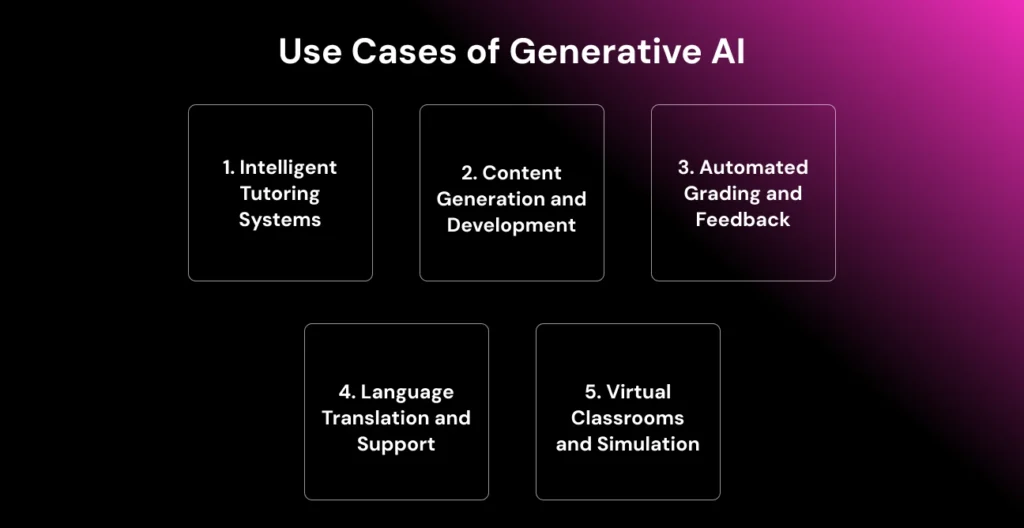
- Intelligent Tutoring Systems: AI app development companies can help in the process of virtual tutors development that is powered by AI. In fact, it helps in the process of serving the purpose of personalizing instruction, answering student queries, and facilitating learning of complex subjects.
- Content Generation and Development: Generative AI enables education app development organizations to generate personalized learning content such as quizzes, assignments, and multimedia content. Education app development organizations generate varied curricular content much quicker because of these tools that are aligned with educational standards.
- Automated Grading and Feedback: Generative AI can speedily grade assignments and exams, offering instant grants with direct qualitative feedback. Because of this technology, educators can spend less time observing student performance and feel confident they will meet student needs on a timely basis.
- Language Translation and Support: Generative AI also supports multilingual classrooms through in-the-moment translation services with pronunciation. This increases communication and competencies.
- Virtual Classrooms and Simulation: Generative AI can lead to AI-powered applications that create immersive learning through simulation or virtual reality. AI-oriented resources offer learners experiential learning, and objectives have a class connection to the learning dynamic that the learners were engaged in.
Also Read: Custom AI or Off-the-Shelf AI? The Ultimate Business Guide
Challenges of Incorporating Gen AI in Education
While generative AI in education has great promise, there are significant issues of concern:
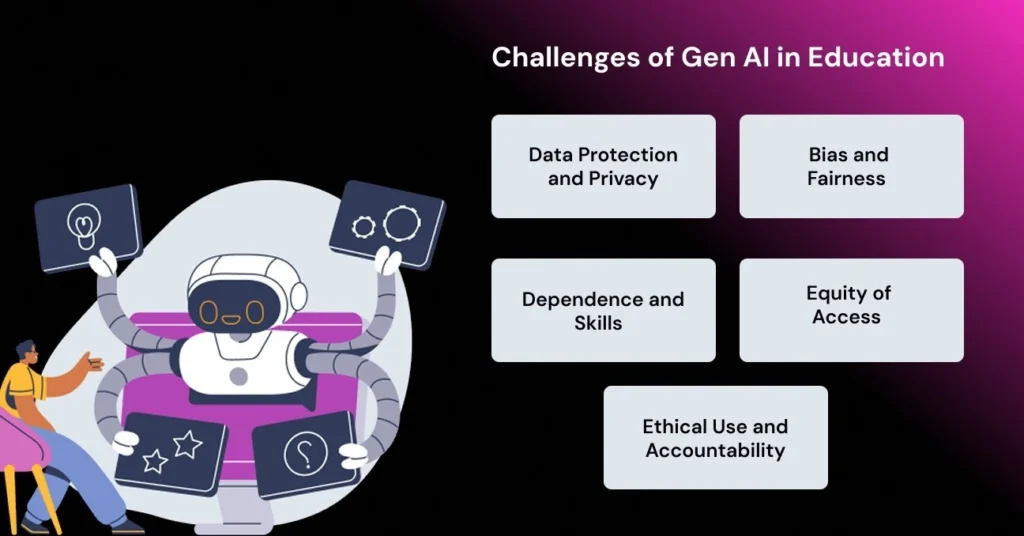
- Data Protection and Privacy: When utilizing AI, student data, including sensitive information, is processed, and those issues raise significant data protection and privacy issues. Educational app developers and AI developers for enterprise and industry must ensure that their systems are compliant with data protection legislation and, if they are operating in education, implement strict protections of user data.
- Bias and Fairness: Generative AI tools could repeat the biases identified in the training data, creating inequity in assessment and learning. Developers must continually test for bias, and promote fairness and equality, as part of the design and development process.
- Dependence and Skills: Heavy use of AI tools may discourage thinking and problem-solving ability, as education is based on the face-to-face interaction of students with a teacher. Educators will need to strike a balance between AI and human methods of teaching to optimize the learning process with both methods.
- Equity of Access: It cannot be assumed that all learners will have equitable access to advanced AI technology, and this could perpetuate educational inequities. There may need to be additional support to enhance continued access to AI tools in education to support learners regardless of historical past or demographic status.
- Ethical Use and Accountability: Finally, there should be a cohesive process for implementing generative AI utilizing a strong ethical framework so all resources can be accountable to ethical practices and principles of transparency related to accountability for how the tools may be used.
Read Also: Top 10 IT Outsourcing Examples: Lessons from Leading Software Companies
Future Trends of GenAI in Education
Generative AI has a bright future in education with a few selective trends on the horizon, including:
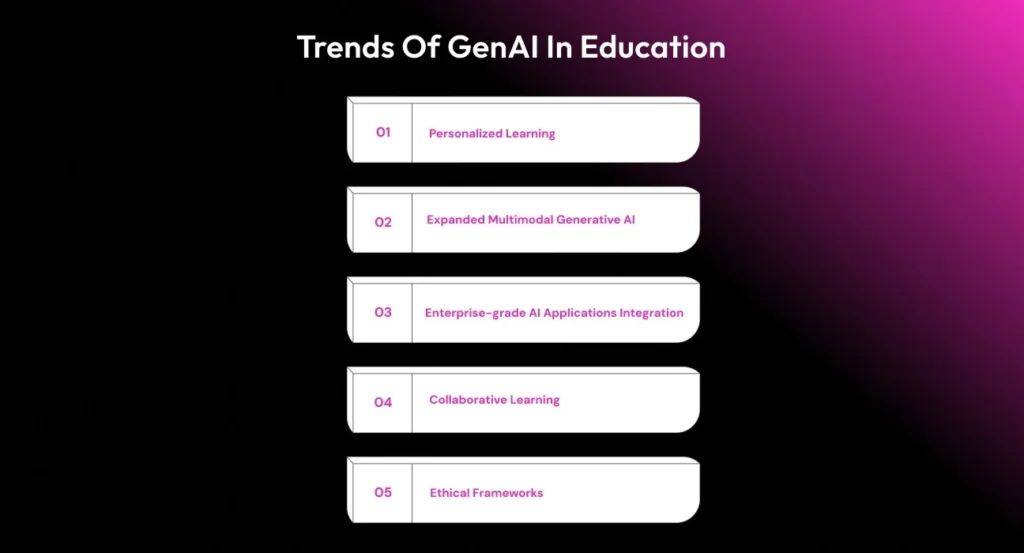
- Personalized Learning
Next-generation AI platforms will allow even greater personalization, drawing in real-time data from multiple sources and creating holistic learner profiles to support adaptive teaching.
- Expanded Multimodal Generative AI
Generative AI will increasingly take advantage of multimodal inputs, including text, audio, video, and gestures, to create enriched interactive learning experiences.
- Enterprise-grade AI Applications Integration
Education providers will begin to use Enterprise-grade AI solutions that integrate generative AI with analytics, administrative and communications tools to facilitate the overall management aspect of education.
- Collaborative Learning
AI-facilitated collaborative platforms will support peer learning and group work, facilitating social interaction and teamwork automatically plus peer-to-peer learning.
- Ethical Frameworks
Standards and regulations will be created for fair, transparent, and ethical use of generative AI in schools through which trust can be established among educators, students, and parents.
Summing Up
So, this shows how generative AI is redefining the education system by facilitating personalized learning experiences, boosting efficiency for educators, and streamlining operations for institutions.
In fact, education and AI app development company experts are at the forefront of building and implementing innovative education solutions for a variety of contexts. Even with challenges like bias and privacy that need to be responsibly addressed, there is great promise in the deployment of generative AI technology alongside enterprise AI solutions in support of an equitable and efficient education worldwide.
If the technology continues to advance, bringing AI into education strategically will enable both educators and students to enhance education in ways that are more equitable, engaging, and adaptive than ever before. All you need is the right hand by your side to have the perfect product. This is where LL Technolab comes into play. Connect now and get your Generative AI educational app in place!
FAQs
Q. What exactly is generative AI in education?
Answer: Generative AI in education is the use of AI systems that create content, personalize learning experiences, and facilitate educational functions through sophisticated techniques of machine learning.
Q. What are the benefits of generative AI for students?
Answer: Generative AI can provide personalized learning pathways, instantaneous feedback, and adaptive tutoring to support students in learning at their own pace and in their own style.
Q. What is the role of education app development companies in the adoption of generative AI?
Answer: Educational app development companies are not only designing but also implementing AI-based apps and platforms using generative AI to foster better educational practice.
Q. Are there ethical issues associated with generative AI and education?
Answer: Yes, ethical issues such as data privacy, bias, dependence on technology, and equitable access need to be thoughtfully dealt with.
Q. What future trends can we expect to see with generative AI in education?
Answer: Future trends will include the expansion of personalized ecosystems, multimodal learning, enterprise AI, collaborative AI tools, and ethical AI.